
Between the Flyover and the Field
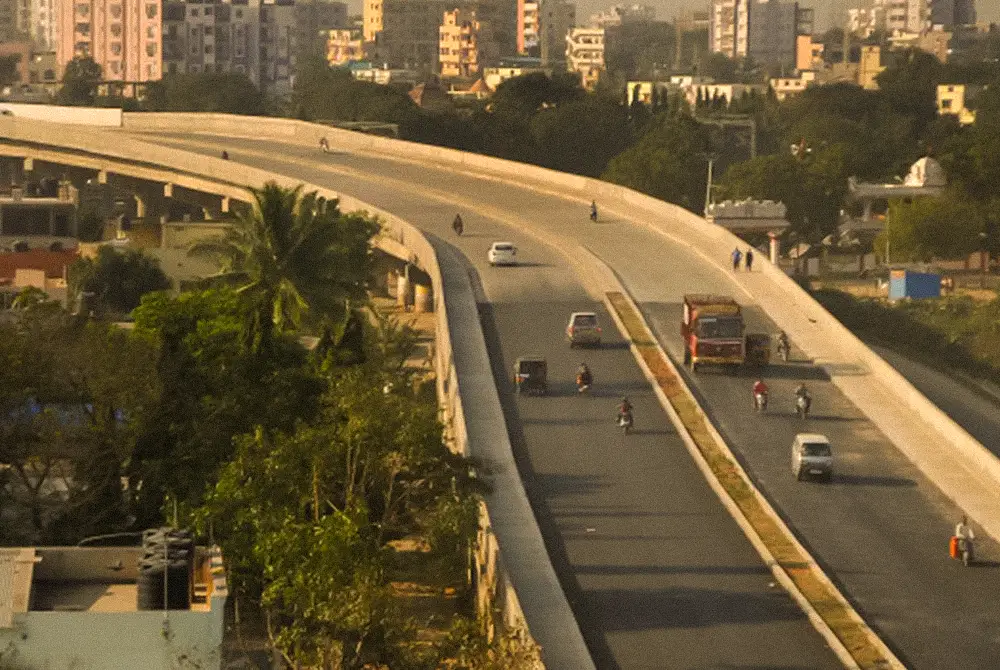
The flyover at Ananthapuram Junction opened quietly.
By the time traffic began to move, the garlands were gone. By evening, cars flowed above the old road where tea stalls once stood. News channels called it progress. Locals called it relief. No one asked what the road beneath would become.
In Hyderabad, progress had learned to arrive without pause.
Glass buildings reflected ambition. Startups launched every week. Metro lines extended like veins of optimism. In the IT corridor, Arjun, a mid level project manager, checked traffic updates each morning before opening his email. His company had announced expansion plans. More floors. More hiring. More speed.
Yet, Arjun’s father, Ramakrishna, no longer followed city news.
He lived in Gundlapadu, a village in Telangana where the bus came twice a day on good days. The borewell had gone dry again. The village WhatsApp group came alive only when electricity returned. Government schemes arrived first as posters and much later as reality.
One evening, Ramakrishna heard a radio announcement about Hyderabad’s new data centers and job growth. He turned it off and walked toward his field. The soil cracked softly under his feet. It did not respond to announcements.
Further south, in coastal Andhra, Kavitha counted days instead of months. The sea had begun entering places it never had before. Fishermen spoke of tides with unfamiliar fear. News articles called it climate variability. For Kavitha, it meant a school that closed twice in one year and a home that needed rebuilding before savings could recover.
She wrote letters. Not emails. Letters. To departments whose addresses she copied from newspapers. Replies were rare. When they came, they thanked her for her patience.
Back in Hyderabad, Arjun attended a townhall meeting. Leaders spoke of smart cities and inclusive growth. Slides moved quickly. Applause arrived on cue. He clapped too, until a photograph appeared on the screen by mistake. A rural school with a tin roof and children sitting on the floor.
The presenter moved past it within seconds.
But Arjun did not.
That night, after weeks of missed calls, he phoned his father. Ramakrishna spoke about the flyover. How trucks moved faster now, but the weekly market had shifted farther away. How young men left earlier each morning and returned later, if they returned at all.
A silence followed.
The next month, something small changed. Not a policy. Not a scheme.
Arjun requested his company to adopt a government school. Not as charity, but as partnership. Internet connectivity was installed. Teachers were supported with training. Remote learning sessions began. Children in Gundlapadu saw the city not with resentment, but with curiosity.
In coastal Andhra, Kavitha’s letters reached a junior officer who had grown up near a similar shoreline. A temporary embankment was approved. Not permanent. Not perfect. But enough to buy time.
Time mattered.
The road beneath Ananthapuram Junction slowly found new life. Vendors returned. Farmers sold produce directly. The old road became human again.
None of this became breaking news.
But society does not move only through headlines.
It moves when cities remember villages as lives, not statistics.
When villages see cities not as betrayals, but as possibilities.
When progress slows just enough to look back.
Between the flyover and the field, India continues to decide who it wants to become.
And that choice still belongs to us.